orx-noise
A collection of noise generator functions. Source and extra documentation can be found in the orx-noise sourcetree.
Prerequisites
If you are working on an
openrndr-template based
project, orx-noise should be ready to use because it is part of the basic
orx bundle, as described in ORX.
Uniformly distributed random values
The library provides extension methods for Double, Vector2, Vector3,
Vector4 to create random vectors easily. To create
scalars and vectors with uniformly distributed noise you use the
uniform extension function.
val d1 = Double.uniform(0.0, 640.0)
val v2 = Vector2.uniform(0.0, 640.0)
val v3 = Vector3.uniform(0.0, 640.0)
val v4 = Vector4.uniform(0.0, 640.0)
To create multiple samples of noise one uses the uniforms function.
val v2 = Vector2.uniforms(100, Vector2(0.0), Vector2(640.0))
val v3 = Vector3.uniforms(100, Vector3(0.0), Vector3(640.0))
The Random class can also be used to generate Double numbers and vector,
but also booleans and integers.
// Boolean
val b = Boolean.random(probability = 0.2)

// Int
val i1 = Int.uniform(0, 640)

// Double
val d2 = Double.uniform(0.0, 640.0)

// Vectors
val v2 = Vector2.uniform(0.0, 640.0)
val v3 = Vector3.uniform(0.0, 640.0)
val v4 = Vector4.uniform(0.0, 640.0)
Perlin, Value and Simplex noise
perlin() and value() accept 2D and 3D arguments, simplex() up to 4D.
All three method take an integer seed as first argument and return a Double.
Some examples:
// Test vectors to use
val v2 = Vector2(0.1, 0.2)
val v4 = Vector4(0.1, 0.2, 0.3, 0.4)

// Now generate random values
val d1 = perlin(1234, 0.1, 0.2)
val d2 = perlin(1248, v2)
val d3 = value(1234, 0.1, 0.2, 0.3)
val d4 = simplex(1234, v4)
Uniform ring noise
val v2 = Vector2.uniformRing(innerRadius = 0.0, outerRadius = 300.0)
val v3 = Vector3.uniformRing(0.0, 300.0)
val v4 = Vector4.uniformRing(0.0, 300.0)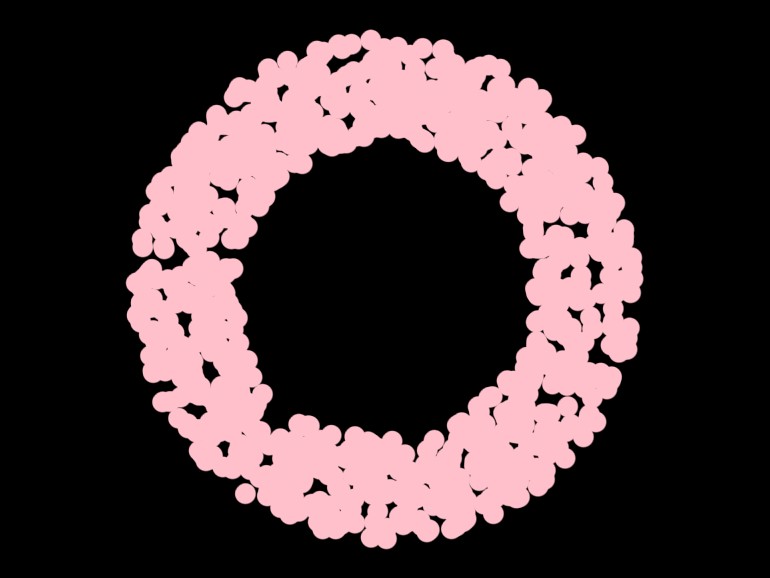
import org.openrndr.application
import org.openrndr.color.ColorRGBa
import org.openrndr.draw.LineCap
import org.openrndr.draw.colorBuffer
import org.openrndr.extra.noise.*
import org.openrndr.extra.noise.filters.CellNoise
import org.openrndr.extra.noise.filters.HashNoise
import org.openrndr.extra.noise.filters.SimplexNoise3D
import org.openrndr.extra.noise.filters.SpeckleNoise
import org.openrndr.extra.noise.filters.ValueNoise
import org.openrndr.extra.noise.primitives.random
import org.openrndr.math.Vector2
import org.openrndr.math.Vector3
import org.openrndr.math.Vector4
import kotlin.math.absoluteValue

fun main() = application {
    program {
        extend {
            drawer.fill = ColorRGBa.PINK
            drawer.stroke = null
            drawer.translate(width / 2.0, height / 2.00)
            for (i in 0 until 1000) {
                drawer.circle(Vector2.uniformRing(150.0, 250.0), 10.0)
            }
        }
    }
}Perlin noise

import org.openrndr.application
import org.openrndr.color.ColorRGBa
import org.openrndr.draw.LineCap
import org.openrndr.draw.colorBuffer
import org.openrndr.extra.noise.*
import org.openrndr.extra.noise.filters.CellNoise
import org.openrndr.extra.noise.filters.HashNoise
import org.openrndr.extra.noise.filters.SimplexNoise3D
import org.openrndr.extra.noise.filters.SpeckleNoise
import org.openrndr.extra.noise.filters.ValueNoise
import org.openrndr.extra.noise.primitives.random
import org.openrndr.math.Vector2
import org.openrndr.math.Vector3
import org.openrndr.math.Vector4
import kotlin.math.absoluteValue

fun main() = application {
    program {
        extend {
            drawer.fill = ColorRGBa.PINK
            drawer.stroke = null
            val scale = 0.005
            for (y in 16 until height step 32) {
                for (x in 16 until width step 32) {
                    val radius = perlinLinear(123, x * scale, y * scale) * 16.0 + 16.0
                    drawer.circle(x * 1.0, y * 1.0, radius)
                }
            }
        }
    }
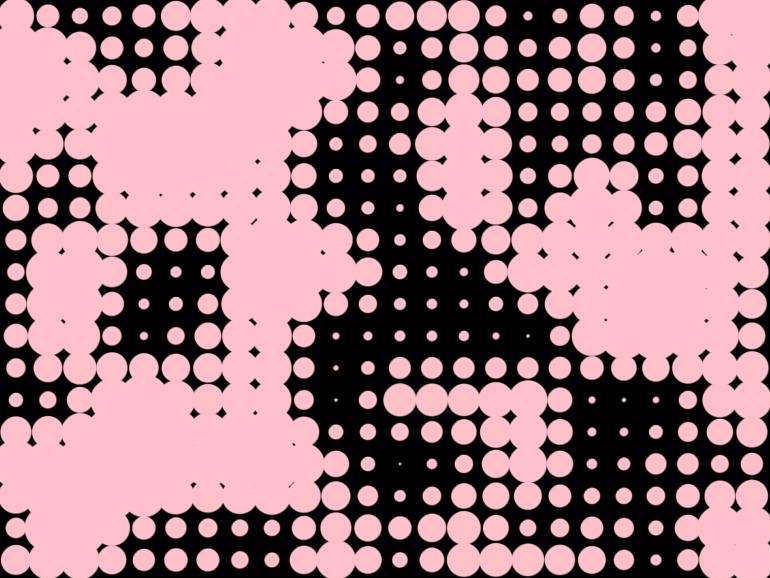
}Value noise
import org.openrndr.application
import org.openrndr.color.ColorRGBa
import org.openrndr.draw.LineCap
import org.openrndr.draw.colorBuffer
import org.openrndr.extra.noise.*
import org.openrndr.extra.noise.filters.CellNoise
import org.openrndr.extra.noise.filters.HashNoise
import org.openrndr.extra.noise.filters.SimplexNoise3D
import org.openrndr.extra.noise.filters.SpeckleNoise
import org.openrndr.extra.noise.filters.ValueNoise
import org.openrndr.extra.noise.primitives.random
import org.openrndr.math.Vector2
import org.openrndr.math.Vector3
import org.openrndr.math.Vector4
import kotlin.math.absoluteValue

fun main() = application {
    program {
        extend {
            drawer.fill = ColorRGBa.PINK
            drawer.stroke = null
            val scale = 0.0150
            for (y in 16 until height step 32) {
                for (x in 16 until width step 32) {
                    val radius = valueLinear(123, x * scale, y * scale) * 16.0 + 16.0
                    drawer.circle(x * 1.0, y * 1.0, radius)
                }
            }
        }
    }
}Simplex noise

import org.openrndr.application
import org.openrndr.color.ColorRGBa
import org.openrndr.draw.LineCap
import org.openrndr.draw.colorBuffer
import org.openrndr.extra.noise.*
import org.openrndr.extra.noise.filters.CellNoise
import org.openrndr.extra.noise.filters.HashNoise
import org.openrndr.extra.noise.filters.SimplexNoise3D
import org.openrndr.extra.noise.filters.SpeckleNoise
import org.openrndr.extra.noise.filters.ValueNoise
import org.openrndr.extra.noise.primitives.random
import org.openrndr.math.Vector2
import org.openrndr.math.Vector3
import org.openrndr.math.Vector4
import kotlin.math.absoluteValue

fun main() = application {
    program {
        extend {
            drawer.fill = ColorRGBa.PINK
            drawer.stroke = null
            val scale = 0.004
            for (y in 16 until height step 32) {
                for (x in 16 until width step 32) {
                    val radius =
                        simplex(123, x * scale, y * scale) * 16.0 + 16.0
                    drawer.circle(x * 1.0, y * 1.0, radius)
                }
            }
        }
    }
}Fractal/FBM noise
import org.openrndr.application
import org.openrndr.color.ColorRGBa
import org.openrndr.draw.LineCap
import org.openrndr.draw.colorBuffer
import org.openrndr.extra.noise.*
import org.openrndr.extra.noise.filters.CellNoise
import org.openrndr.extra.noise.filters.HashNoise
import org.openrndr.extra.noise.filters.SimplexNoise3D
import org.openrndr.extra.noise.filters.SpeckleNoise
import org.openrndr.extra.noise.filters.ValueNoise
import org.openrndr.extra.noise.primitives.random
import org.openrndr.math.Vector2
import org.openrndr.math.Vector3
import org.openrndr.math.Vector4
import kotlin.math.absoluteValue

fun main() = application {
    program {
        extend {
            drawer.fill = ColorRGBa.PINK
            drawer.stroke = null
            val s = 0.0080
            val t = seconds
            for (y in 4 until height step 8) {
                for (x in 4 until width step 8) {
                    val radius = when {
                        t < 3.0 -> fbm(135, x * s, y * s, t, ::perlinLinear).absoluteValue * 16.0
                        t < 6.0 -> billow(471, x * s, y * s, t, ::perlinLinear) * 2.0
                        else -> rigid(193, x * s, y * s, t, ::perlinLinear) * 16.0
                    }
                    drawer.circle(x * 1.0, y * 1.0, radius)
                }
            }
        }
    }
}Noise gradients
Noise functions have evaluable gradients, a direction to where the
value of the function increases the fastest. The gradient1D,
gradient2D, gradient3D and gradient4D functions can be used
to estimate gradients for noise functions.
import org.openrndr.application
import org.openrndr.color.ColorRGBa
import org.openrndr.draw.LineCap
import org.openrndr.draw.colorBuffer
import org.openrndr.extra.noise.*
import org.openrndr.extra.noise.filters.CellNoise
import org.openrndr.extra.noise.filters.HashNoise
import org.openrndr.extra.noise.filters.SimplexNoise3D
import org.openrndr.extra.noise.filters.SpeckleNoise
import org.openrndr.extra.noise.filters.ValueNoise
import org.openrndr.extra.noise.primitives.random
import org.openrndr.math.Vector2
import org.openrndr.math.Vector3
import org.openrndr.math.Vector4
import kotlin.math.absoluteValue

fun main() = application {
    program {
        extend {
            drawer.fill = null
            drawer.stroke = ColorRGBa.PINK
            drawer.lineCap = LineCap.ROUND
            drawer.strokeWeight = 3.0
            val t = seconds
            for (y in 4 until height step 8) {
                for (x in 4 until width step 8) {
                    val g = gradient3D(
                        ::perlinQuintic, 100,
                        x * 0.005, y * 0.005, t, 0.0005
                    ).xy
                    drawer.lineSegment(
                        Vector2(x * 1.0, y * 1.0) - g * 2.0,
                        Vector2(x * 1.0, y * 1.0) + g * 2.0
                    )

                }
            }
        }
    }
}Gradients can also be calculated for the fbm, rigid and billow versions
of the noise functions. However,
we first have to create a function that can be used by the gradient
estimator. For this .fbm(), .billow(), and
.rigid() can be used (which works through
partial application).
import org.openrndr.application
import org.openrndr.color.ColorRGBa
import org.openrndr.draw.LineCap
import org.openrndr.draw.colorBuffer
import org.openrndr.extra.noise.*
import org.openrndr.extra.noise.filters.CellNoise
import org.openrndr.extra.noise.filters.HashNoise
import org.openrndr.extra.noise.filters.SimplexNoise3D
import org.openrndr.extra.noise.filters.SpeckleNoise
import org.openrndr.extra.noise.filters.ValueNoise
import org.openrndr.extra.noise.primitives.random
import org.openrndr.math.Vector2
import org.openrndr.math.Vector3
import org.openrndr.math.Vector4
import kotlin.math.absoluteValue

fun main() = application {
    program {
        val noise = simplex3D.fbm(octaves = 3)
        extend {
            drawer.fill = null
            drawer.stroke = ColorRGBa.PINK
            drawer.lineCap = LineCap.ROUND
            drawer.strokeWeight = 1.5
            val t = seconds
            for (y in 4 until height step 8) {
                for (x in 4 until width step 8) {
                    val g = gradient3D(
                        noise, 100, x * 0.002, y * 0.002, t, 0.002
                    ).xy
                    drawer.lineSegment(
                        Vector2(x * 1.0, y * 1.0) - g * 1.0,
                        Vector2(x * 1.0, y * 1.0) + g * 1.0
                    )
                }
            }
        }
    }
}Noise filters
The library contains a number of Filters with which noise image can be generated efficiently on the GPU.
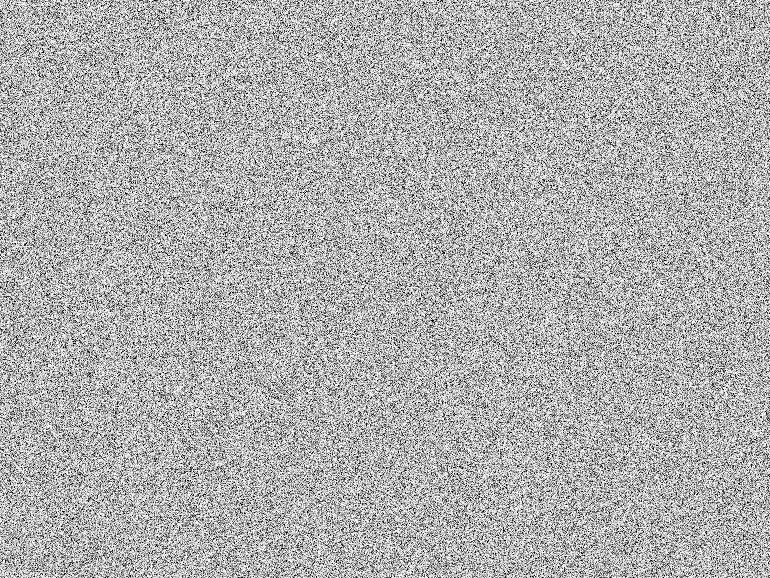
Hash noise
A white-noise-like noise generator.
| Parameter | Default value | Description |
|---|---|---|
seed | 0.0 | Noise seed |
gain | Vector4(1.0, 1.0, 1.0, 0.0) | Noise gain per channel |
bias | Vector4(0.0, 0.0, 0.0, 1.0) | Value to add to the generated noise |
monochrome | true | Outputs monochrome noise if true |
premultipliedAlpha | true | Outputs premultiplied alpha if true |
import org.openrndr.application
import org.openrndr.color.ColorRGBa
import org.openrndr.draw.LineCap
import org.openrndr.draw.colorBuffer
import org.openrndr.extra.noise.*
import org.openrndr.extra.noise.filters.CellNoise
import org.openrndr.extra.noise.filters.HashNoise
import org.openrndr.extra.noise.filters.SimplexNoise3D
import org.openrndr.extra.noise.filters.SpeckleNoise
import org.openrndr.extra.noise.filters.ValueNoise
import org.openrndr.extra.noise.primitives.random
import org.openrndr.math.Vector2
import org.openrndr.math.Vector3
import org.openrndr.math.Vector4
import kotlin.math.absoluteValue

fun main() = application {
    program {
        val cb = colorBuffer(width, height)
        val hn = HashNoise()
        extend {
            hn.seed = seconds
            hn.apply(emptyArray(), cb)
            drawer.image(cb)
        }
    }
}3D Simplex noise filter
The SimplexNoise3D filter is based on Ken Perlin’s improvement
over Perlin noise, but with fewer directional artifacts and, in
higher dimensions, a lower computational overhead.
| Parameter | Default value | Description |
|---|---|---|
seed | Vector3(0.0, 0.0, 0.0) | Noise seed / offset |
scale | Vector3(1.0, 1.0, 1.0) | The noise scale at the first octave |
octaves | 4 | The number of octaves |
gain | Vector4(0.5, 0.5, 0.5, 0.5) | Noise gain per channel per octave |
decay | Vector4(0.5, 0.5, 0.5, 0.5) | Noise decay per channel per octave |
bias | Vector4(0.5, 0.5, 0.5, 0.5) | Value to add to the generated noise |
lacunarity | Vector4(2.0, 2.0, 2.0, 2.0) | Multiplication of noise scale per octave |
premultipliedAlpha | true | Outputs premultiplied alpha if true |
import org.openrndr.application
import org.openrndr.color.ColorRGBa
import org.openrndr.draw.LineCap
import org.openrndr.draw.colorBuffer
import org.openrndr.extra.noise.*
import org.openrndr.extra.noise.filters.CellNoise
import org.openrndr.extra.noise.filters.HashNoise
import org.openrndr.extra.noise.filters.SimplexNoise3D
import org.openrndr.extra.noise.filters.SpeckleNoise
import org.openrndr.extra.noise.filters.ValueNoise
import org.openrndr.extra.noise.primitives.random
import org.openrndr.math.Vector2
import org.openrndr.math.Vector3
import org.openrndr.math.Vector4
import kotlin.math.absoluteValue

fun main() = application {
    program {
        val cb = colorBuffer(width, height)
        val sn = SimplexNoise3D()
        extend {
            sn.seed = Vector3(0.0, 0.0, seconds * 0.1)
            sn.scale = Vector3.ONE * 2.0
            sn.octaves = 8
            sn.premultipliedAlpha = false
            sn.apply(emptyArray(), cb)
            drawer.image(cb)
        }
    }
}Cell noise
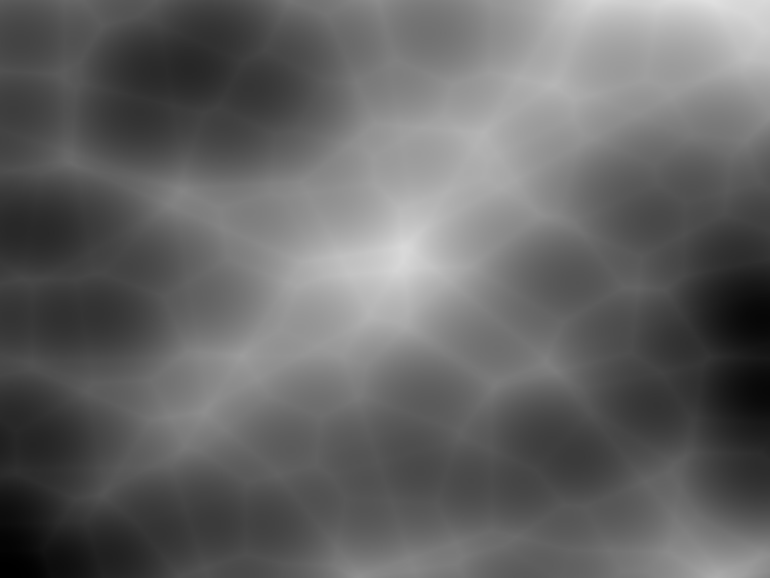
A cell, Worley or Voronoi noise generator
| Parameter | Default value | Description |
|---|---|---|
seed | Vector2(0.0, 0.0) | Noise seed / offset |
scale | Vector2(1.0, 1.0) | The noise scale at the first octave |
octaves | 4 | The number of octaves |
gain | Vector4(1.0, 1.0, 1.0, 0.0) | Noise gain per channel per octave |
decay | Vector4(0.5, 0.5, 0.5, 0.5) | Noise decay per channel per octave |
bias | Vector4(0.0, 0.0, 0.0, 1.0) | Value to add to the generated noise |
lacunarity | Vector4(2.0, 2.0, 2.0, 2.0) | Multiplication of noise scale per octave |
premultipliedAlpha | true | Outputs premultiplied alpha if true |
import org.openrndr.application
import org.openrndr.color.ColorRGBa
import org.openrndr.draw.LineCap
import org.openrndr.draw.colorBuffer
import org.openrndr.extra.noise.*
import org.openrndr.extra.noise.filters.CellNoise
import org.openrndr.extra.noise.filters.HashNoise
import org.openrndr.extra.noise.filters.SimplexNoise3D
import org.openrndr.extra.noise.filters.SpeckleNoise
import org.openrndr.extra.noise.filters.ValueNoise
import org.openrndr.extra.noise.primitives.random
import org.openrndr.math.Vector2
import org.openrndr.math.Vector3
import org.openrndr.math.Vector4
import kotlin.math.absoluteValue

fun main() = application {
    program {
        val cb = colorBuffer(width, height)
        val cn = CellNoise()
        extend {
            cn.octaves = 4
            cn.apply(emptyArray(), cb)
            drawer.image(cb)
        }
    }
}Speckle noise
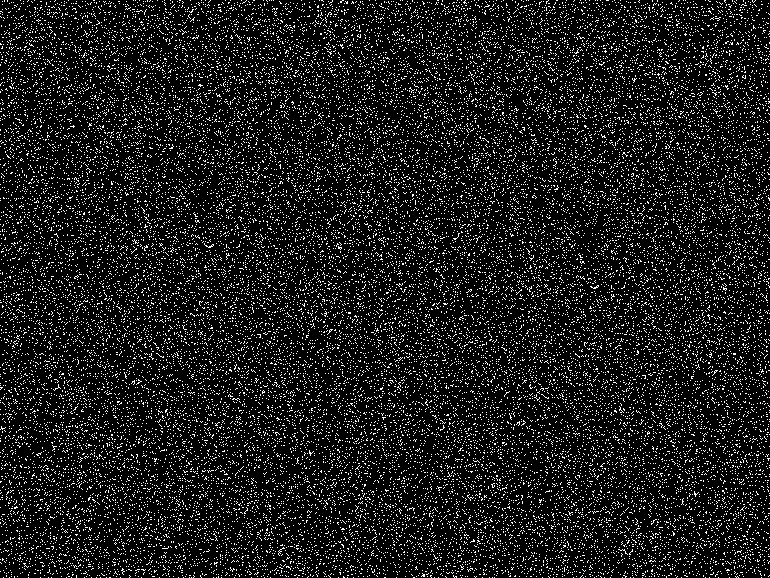
A speckle noise generator.
| Parameter | Default value | Description |
|---|---|---|
color | ColorRGBa.WHITE | Speckle color |
density | 1.0 | Speckle density |
seed | 0.0 | Noise seed |
noise | 0.0 | Speckle noisiness |
premultipliedAlpha | true | Outputs premultiplied alpha if true |
import org.openrndr.application
import org.openrndr.color.ColorRGBa
import org.openrndr.draw.LineCap
import org.openrndr.draw.colorBuffer
import org.openrndr.extra.noise.*
import org.openrndr.extra.noise.filters.CellNoise
import org.openrndr.extra.noise.filters.HashNoise
import org.openrndr.extra.noise.filters.SimplexNoise3D
import org.openrndr.extra.noise.filters.SpeckleNoise
import org.openrndr.extra.noise.filters.ValueNoise
import org.openrndr.extra.noise.primitives.random
import org.openrndr.math.Vector2
import org.openrndr.math.Vector3
import org.openrndr.math.Vector4
import kotlin.math.absoluteValue

fun main() = application {
    program {
        val cb = colorBuffer(width, height)
        val sn = SpeckleNoise()
        extend {
            sn.seed = seconds
            sn.apply(emptyArray(), cb)
            drawer.image(cb)
        }
    }
}Value noise
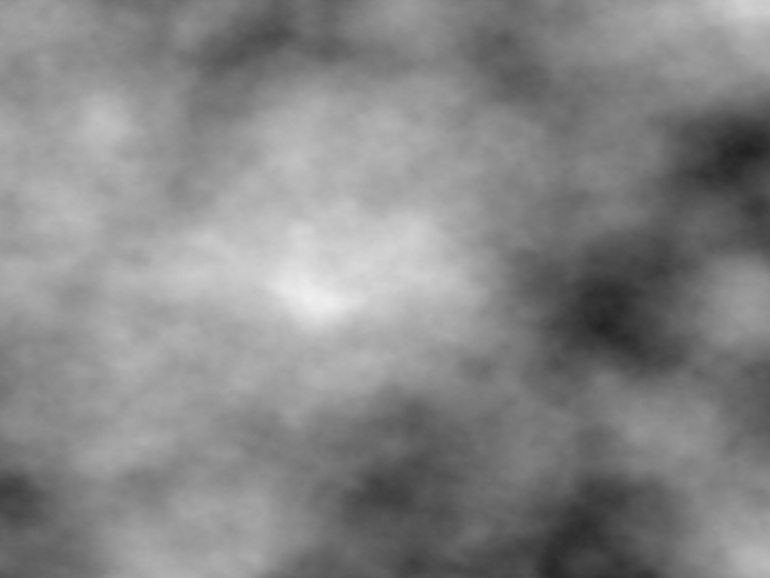
The ValueNoise filter generates a simple fractal noise. Value
noise is a computationally cheap form of creating
‘smooth noise’ by interpolating random values on a lattice.
| Parameter | Default value | Description |
|---|---|---|
seed | Vector2(0.0, 0.0) | Noise seed / offset |
scale | Vector2(1.0, 1.0) | The noise scale at the first octave |
octaves | 4 | The number of octaves |
gain | Vector4(1.0, 1.0, 1.0, 0.0) | Noise gain per channel per octave |
decay | Vector4(0.5, 0.5, 0.5, 0.5) | Noise decay per channel per octave |
bias | Vector4(0.0, 0.0, 0.0, 1.0) | Value to add to the generated noise |
lacunarity | Vector4(2.0, 2.0, 2.0, 2.0) | Multiplication of noise scale per octave |
premultipliedAlpha | true | Outputs premultiplied alpha if true |
import org.openrndr.application
import org.openrndr.color.ColorRGBa
import org.openrndr.draw.LineCap
import org.openrndr.draw.colorBuffer
import org.openrndr.extra.noise.*
import org.openrndr.extra.noise.filters.CellNoise
import org.openrndr.extra.noise.filters.HashNoise
import org.openrndr.extra.noise.filters.SimplexNoise3D
import org.openrndr.extra.noise.filters.SpeckleNoise
import org.openrndr.extra.noise.filters.ValueNoise
import org.openrndr.extra.noise.primitives.random
import org.openrndr.math.Vector2
import org.openrndr.math.Vector3
import org.openrndr.math.Vector4
import kotlin.math.absoluteValue

fun main() = application {
    program {
        val cb = colorBuffer(width, height)
        val vn = ValueNoise()
        extend {
            vn.scale = Vector2.ONE * 4.0
            vn.gain = Vector4.ONE * 0.5
            vn.octaves = 8
            vn.apply(emptyArray(), cb)
            drawer.image(cb)
        }
    }
}