Shade style presets
The orx-shade-styles library provides a number of preset shade styles
Prerequisites
If you are working on an openrndr-template based project, orx-shade-styles should be ready to use because it is part of the basic orx bundle, as described in ORX.
Linear gradient
The gradient shade style constructor is a powerful generator for gradients. In the background it produces GLSL code that runs in the GPU. It accepts an arbitrary number of colors between stops[0.0] and stops[1.0].
fun main() = application {
    program {
        val image = loadImage("data/images/cheeta.jpg")
        val font = loadFont("data/fonts/default.otf", 144.0)
        extend {
            drawer.shadeStyle = gradient<ColorRGBa> {
                stops[0.0] = ColorRGBa.PINK
                stops[0.8] = ColorRGBa.ORANGE
                stops[1.0] = ColorRGBa.RED
                linear {
                    start = Polar(seconds * 60.0, 0.5).cartesian + 0.5
                    end = Polar(seconds * 60.0 + 180.0, 0.5).cartesian + 0.5
                }
            }
            drawer.rectangle(80.0, 40.0, 200.0, 200.0)
            drawer.circle(180.0, 340.0, 90.0)
            drawer.image(image, 300.0, 40.0, 640 * (200 / 480.0), 200.0)
            drawer.fontMap = font
            drawer.text("OPEN", 300.0, 340.0)
            drawer.text("RNDR", 300.0, 420.0)
        }
    }
}
Radial gradient
Radial gradients blend colors based on the distance to a center point. In this example the center point’s x and y coordinates are animated using the sine and cosine of time.
drawer.shadeStyle = gradient<ColorRGBa> {
    stops[0.0] = ColorRGBa.PINK
    stops[1.0] = ColorRGBa.RED
    radial {
        radius = 0.5
        center = Vector2(cos(seconds), sin(seconds * 2.0)) * 0.5 + 0.5
    }
}
Conic gradient
Here we can see that ColorOKLABa is also supported by the gradient generator.
drawer.shadeStyle = gradient<ColorOKLABa> {
    stops[0.0] = ColorRGBa.PINK.toOKLABa()
    stops[1.0] = ColorRGBa.PURPLE.toOKLABa()
    conic {
        rotation = seconds * 60.0
    }
}
Mirrored conic gradient
Here we increase the angle to 720.0 and use SpreadMethod.REFLECT to mirror the gradient.
drawer.shadeStyle = gradient<ColorRGBa> {
    stops[0.0] = ColorRGBa.PINK
    stops[1.0] = ColorRGBa.RED
    spreadMethod = SpreadMethod.REFLECT
    conic {
        angle = 360.0 * 2
        rotation = seconds * 60.0
    }
}
Quantize and levelWarpFunction
This program demonstrates two more gradient features. The first one is quantization, which lets us define how many discrete colors we want our gradient to have.
The second new feature is an advanced one: levelWarpFunction lets us inject custom GLSL code into our shader to modify the gradient level based on the default level, on the pixel’s coordinates, or both. We apply here a very simple adjustment, to elevate the level to a power of 1.0, 2.0 or 3.0, which skews the balance between white and black.
When using levelWarpFunction, provide a string formatted like this: float levelWarp(vec2 p, float level) { return ___; } where ___ evaluates to a float, typically based in the p and/or level arguments.
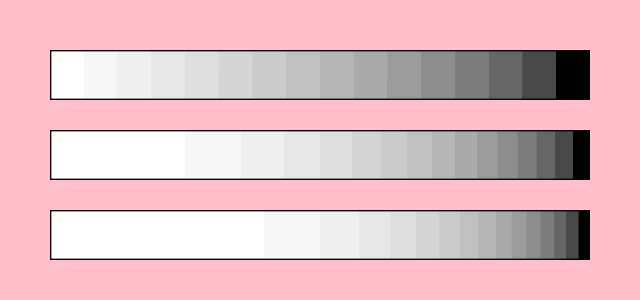
fun main() = application {
    program {
        extend {
            drawer.clear(ColorRGBa.PINK)
            repeat(3) {
                val e = it + 1.0
                drawer.shadeStyle = gradient<ColorRGBa> {
                    stops[0.0] = ColorRGBa.WHITE
                    stops[1.0] = ColorRGBa.BLACK
                    quantization = 16
                    levelWarpFunction = "float levelWarp(vec2 p, float level) { return pow(level, $e); }"
                    linear { }
                }
                drawer.rectangle(50.0, 50.0 + it * 80.0, width - 100.0, 50.0)
            }
        }
    }
}
domainWarpFunction
One more advanced feature available to us is domainWarpFunction, which lets us inject custom GLSL code into our shader to distort the gradient calculations based on the pixel’s coordinates.
When using levelWarpFunction, provide a string formatted like this: vec2 domainWarp(vec2 coord) { return ___; } where ___ evaluates to a vec2 based on the input coord.
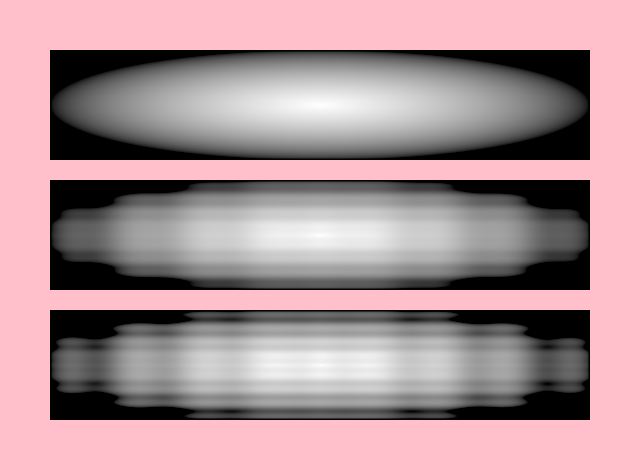
fun main() = application {
    program {
        extend {
            drawer.clear(ColorRGBa.PINK)
            repeat(3) {
                val e = it * 0.02
                drawer.shadeStyle = gradient<ColorRGBa> {
                    stops[0.0] = ColorRGBa.WHITE
                    stops[1.0] = ColorRGBa.BLACK
                    domainWarpFunction = "vec2 domainWarp(vec2 p) { return p + sin(p * 50.0) * $e; }"
                    radial { }
                }
                drawer.rectangle(50.0, 50.0 + it * 130.0, width - 100.0, 110.0)
            }
        }
    }
}
For more examples, explore the available gradient demos.