Collection in Kotlin
The Collections in Kotlin’s standard library are powerful tools for computational design and creative purposes. It provides Lists, Maps and Sets with mutable and immutable variants.
Each of these data structures has many methods for querying and manipulating its elements, which can then be made visible using OPENRNDR’s drawing capabilities.
List
A list is a collection of elements of the same type. Let’s see some immutable List examples:
// Create an immutable list with specific Integers
val list = listOf(1, 2, 3, 5, 7)

// Accessing elements
println(list[0]) // 1
println(list.first()) // 1
println(list.last()) // 7

println(list.size) // 5
println(list.lastIndex) // 4
We can also create lists using the List constructor:
// Generate a list of 10 random numbers
val randomNumbers = List(10) {
    Math.random().toInt()
}

// Generate a list of even numbers
val evenNumbers = List(10) {
    it * 2
}
Once we have a list, we can iterate over its elements:
val list = listOf(1, 2, 3, 4, 5)
for (item in list) {
    println(item)
}
forEach and forEachIndexed can also be used to iterate over a list, although breaking out of the loop is not possible with them.
val list = listOf(2, 7, 7, 1, 100)

list.forEach { println(it) }

list.forEachIndexed { index, item ->
    println("$index: $item")
}
Mutable lists behave mostly like immutable lists, but they can be modified:
val mutableList = mutableListOf(1, 2, 3, 4, 5)
mutableList.add(6) // 1, 2, 3, 4, 5, 6
mutableList.remove(0) // 2, 3, 4, 5, 6
Lists provide many useful methods, such as filter, map, sortedBy, groupBy, chunked, and others. We will not discuss them all in detail in this introduction, but here some examples:
val list = List(16) { it } // Integers between 0 and 15
val evenNumbers = list.filter { it % 2 == 0 }
val squares = list.map { it * it }
val shuffled = list.shuffled()
val first5 = list.take(5)
val last5 = list.takeLast(5)
val asDouble = list.map { it.toDouble() }
Visual examples
We haven’t yet taken a look at any drawing operations, so don’t worry if you don’t yet fully understand how that works, it will be introduced in next chapters.
These examples are just to give you a taste of how lists can be used to create visual output.
Here’s how to create and use a list with 20 double value:

import org.intellij.lang.annotations.Language
import org.openrndr.application
import org.openrndr.color.ColorHSVa
import org.openrndr.color.ColorRGBa
import org.openrndr.math.Vector2
import org.openrndr.shape.LineSegment

fun main() = application {
    program {
        // A list containing 1.0, 2.0, 5.0, 10.0, 17.0 ...
        val radii = List(20) { i -> 1.0 + i * i }
        extend {
            drawer.clear(ColorRGBa.WHITE)
            drawer.fill = null
            drawer.stroke = ColorRGBa.PINK
            // Go over each radius in the list and use it
            // for the stroke weight and the radius of a circle
            radii.forEach { radius ->
                drawer.strokeWeight = radius * 0.1
                drawer.circle(drawer.bounds.center, radius)
            }
        }
    }
}
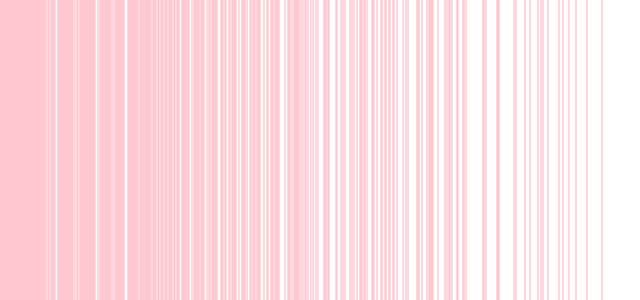
And one final example populating a list of Double values, then filtering out some items, and finally mapping the remaining elements into LineSegment instances.
import org.intellij.lang.annotations.Language
import org.openrndr.application
import org.openrndr.color.ColorHSVa
import org.openrndr.color.ColorRGBa
import org.openrndr.math.Vector2
import org.openrndr.shape.LineSegment

fun main() = application {
    program {
        // Generate a list containing values between 0.0 and 1.0
        val x = List(width) { it.toDouble() / width }

        // Filter out high `x` values.
        // The condition is likely to be false for high `it` values, making them fail the test.
        val filtered = x.filter { Math.random() > it }

        // Map the lucky Double values to LineSegment instances.
        // `segs` is a `List<LineSegment>` and `it` is the current list element being processed (a double).
        val segs = filtered.map {
            LineSegment(it * width, 0.0, it * width, height.toDouble())
        }
        extend {
            drawer.clear(ColorRGBa.WHITE)
            drawer.stroke = ColorRGBa.PINK
            // Draw the line segments in our list
            drawer.lineSegments(segs)
        }
    }
}
Map
Maps and Sets are arguably more niche data structures than lists, but it’s still worth mentioning them.
A map is a collection of key-value pairs, sometimes known as a dictionary. There are two main constructors for maps: mapOf() and mutableMapOf().
// Create maps from integers to strings
val map = mapOf(1 to "one", 2 to "two", 3 to "three")
val mutableMap = mutableMapOf(1 to "one", 2 to "two", 3 to "three")

println(map[2]) // two
mutableMap[4] = "four" // add `4 to "four"` to the mutable map
mutableMap.remove(2) // remove a pair from the mutable map

// Create a map from a list of numbers to their squares
val squares = listOf(1, 3, 7).associateWith { it * it }
println(squares) // {1=1, 3=9, 7=49}
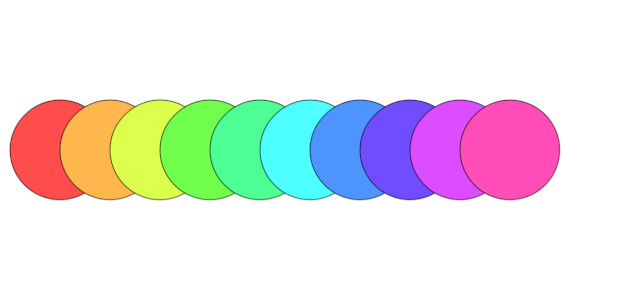
An example with a mutable map containing positions to colors.
import org.intellij.lang.annotations.Language
import org.openrndr.application
import org.openrndr.color.ColorHSVa
import org.openrndr.color.ColorRGBa
import org.openrndr.math.Vector2
import org.openrndr.shape.LineSegment

fun main() = application {
    program {
        // Notice how we can specify the key and value types
        val data = mutableMapOf<Vector2, ColorRGBa>()
        // Populate the map with 10 positions and colors
        repeat(10) {
            val pos = Vector2(60.0 + 50.0 * it, height * 0.5)
            val color = ColorHSVa(it * 36.0, 0.7, 1.0).toRGBa()
            data[pos] = color
        }
        extend {
            drawer.clear(ColorRGBa.WHITE)
            // Iterate over all the map items using the position and color of each
            data.forEach { (pos, c) ->
                drawer.fill = c
                drawer.circle(pos, 50.0)
            }
        }
    }
}
Set
A set is a collection of unique elements.
There are two main constructors for sets: setOf() and mutableSetOf().
// Immutable set
val s = setOf(1, 2, 3, 4, 5, 5, 5)
println(s) // [1, 2, 3, 4, 5]
println(s.contains(6)) // false

// Mutable set
val mutableS = mutableSetOf(1, 2, 3, 4, 5)
println(mutableS.add(6)) // true (added successfully)
println(mutableS.add(6)) // false (not added, already there)
println(mutableS.remove(3)) // true (removed successfully)
println(mutableS.remove(3)) // false (item does not exist)
One can also convert a list into a set to make sure its elements are unique:
val nonUnique = List(20) {
    (Math.random() * 10).toInt()
}
val unique = nonUnique.toSet()
println(nonUnique) // [4, 1, 4, 1, 0, 1, 4, 1, 1, 0]
println(unique) // [4, 1, 0]
There are endless possibilities with Lists, Sets, and Maps. Learn more about them in the Kotlin standard library documentation.